
Learn to Trade
A free education library on price action, market structure, liquidity, sessions, risk, and how traders actually fund an account. No signup. This is the vocabulary of the chart, written at the depth of a real education site, not a three-line glossary. The Academy on Discord is where that vocabulary becomes one connected process.
What Red Box is, and what this hub is for
Red Box Technical Analysis is an educational platform focused on technical analysis for scalping and day trading. We teach you how to read the market, prepare your charts and execute with a structured process. No signals, no calls, no managed money. You learn to do the reading yourself, in a fixed order, and you get tested on each stage before you move to the next one.
This hub is the free half of that. Most trading sites give you a heading, two paragraphs, and a button to buy. That is not enough to learn anything, and it is not enough for someone who typed a real question into Google. Red Box Learn is built as a library: forty free lessons with diagrams, worked US30 examples, glossaries, common mistakes, and links that send you to the next idea in the chain rather than to a dead end.
You can read in order or jump straight to the term you searched. If you are new, start with what technical analysis is, then candlesticks and highs and lows. Those three lessons are the grammar. After that, market structure is the map, and liquidity explains why price so often visits the obvious high or low before the real move.
Learn is not the Academy
Learn is public on purpose. It is vocabulary and screen time homework you can do tonight on a replay chart. It will not assign you a Discord role, it will not grade a stage test, and it will not tell you when to click. The paid Academy is a four stage curriculum that already lives in Discord: Foundation, Recognition, Preparation, Execution. The lower plan covers Stages 1 to 3 plus the Stage 3 community chat. The higher plan adds Stage 4 and its chat.
If you arrived looking for signals, you are on the wrong site. If you arrived looking for the difference between a liquidity sweep and a break of structure, you are in the right place. Read until you can explain that difference in one paragraph without copying a tweet.
How to use the library
Open one instrument and stay with it. US30 is the example we use most, because its session levels are unusually easy to see. Stay on one working timeframe long enough to watch a full London or New York story play out. After each lesson, find one live example. Write one sentence: price did X, then Y. That sentence is the work. Ten articles you only skim will not change how you see a wick through yesterday's high.
- Technical analysis. Reading the chart: structure, liquidity, gaps, candles, timeframes.
- Trading. Style, plan, psychology, risk, stops, and size.
- Markets and instruments. Forex, indices, futures, CFDs, stocks, and the three sessions.
- Trading capital. Prop firms versus your own money, rules, and how much capital you actually need.
When you can mark a high, name the session, and say whether a poke held or failed, you have enough vocabulary to understand what the Academy is asking you to practise. Until then, stay here. The course is not a shortcut around this page.
The ideas, drawn
Four of the core lessons as diagrams you can actually read, then open the full article and find the same thing on a live chart.


Four doors into the library
Technical Analysis
11 lessons: price action, market structure, support and resistance, highs and lows, liquidity, sweeps, fair value gaps, break of structure, candlesticks, and timeframes, with diagrams and worked US30 examples.
Trading
10 lessons: day trading, scalping, strategy, the written plan, psychology, risk, risk/reward, stop placement, and position sizing, the practical side after you can read the chart.
Markets & Instruments
9 lessons: forex, indices, futures, CFDs, stocks, and why Asian, London, and New York sessions change the same level on the same chart.
Trading Capital
10 lessons: prop firms, challenges, funded accounts, firm rules, personal capital, and how to choose a vehicle that actually fits your process.
Every free lesson, in one place
Forty articles. Open any title for the full lesson, examples, mistakes, and the next page in the chain. This is the copy: not a card with one sentence, the actual education.
Technical analysis
Open categoryWhat is technical analysis?
The skill of reading a chart, candlesticks, highs and lows, and the sequence they form, instead of waiting for a signal or an indicator to turn green. This is the starting point for every other lesson on the hub.
Price action
What price itself is doing in real time: wicks, bodies, tests, and rejections. If you cover every oscillator and still cannot say whether the last high held, you are not reading the market yet.
Market structure
Uptrend, downtrend, or range, named from the sequence of swing highs and swing lows. Until you can say which of those three is true, you are staring at candles instead of using a map.
Support and resistance
Zones where the auction previously failed or held. A level is a location to watch, not a trade. The useful ones are obvious; a maze of lines is usually comfort, not analysis.
Highs and lows
The three-candle pivot that every structure idea is built on. If you cannot mark a high and a low the same way tomorrow morning, it was not a high or a low.
Liquidity
The orders sitting above obvious highs and below obvious lows. Price often visits those pools before the real move. You do not need a conspiracy theory, you need to see the magnet.
Liquidity sweeps
When price takes the obvious high or low and fails to hold. A wick through a level is not automatically a break of structure. This lesson is how you stop mixing the two.
Fair value gaps
The imbalance left by a fast, one-sided move. A gap is an area to watch on the way back, never a promise of an entry on its own.
Break of structure
A close that holds beyond a swing point, not a wick that immediately fails. Timeframe, which swing, and whether the next candle reclaims: that checklist is the whole lesson.
Candlesticks
Open, high, low, close, one period at a time. A hammer at the lows after a sweep is information. The same hammer in the middle of a range is a pause. Location writes the sentence.
Timeframes
The 15-minute can trend while the 4-hour ranges. Bias from the higher timeframe, location from the working chart, timing last. If they disagree, you stand aside.
Trading
Open categoryWhat is trading?
Buying and selling a market to capture a move, not investing, not guessing news. Mechanics first: instrument, session, risk, and a reason you can write down before you click.
Day trading
Opening and closing inside a session so overnight risk is not the default. Built around session opens, prior-day levels, and a plan that ends when the tape goes quiet.
Scalping
The fastest style: small targets, tight invalidation, high screen time. It only works if your reading is already fast. Speed without structure is just clicking.
Trading strategies
A strategy is more than a setup screenshot. It needs market, session, invalidation, size, and what you do when the idea is wrong. Isolated patterns are not a strategy.
Trading plan
The written rules you follow when you are bored, tilted, or late. If it only lives in your head, it will change the first time a candle goes against you.
Trading psychology
Most account damage is behavioral: revenge, size-up after a win, skipping the no-trade day. Process is how you make those expensive in a journal instead of live.
Risk management
The skill that keeps one bad trade from ending the week. Defined loss first, then the idea. Without this, every other lesson is decoration.
Risk / reward
Win rate alone never tells the story. A 40% win rate with 2R winners can beat a 70% win rate that pays 0.4R. The math has to match how you actually exit.
Stop loss
The order that defines exactly how much you are willing to lose if the read is wrong. Place it where the idea is invalid, not where it “feels safe.”
Position sizing
Turning a risk percentage into a lot size. Same idea, different account, different size. This is how you stop treating every chart as the same bet.
Markets & instruments
Open categoryForex
One currency against another, 24 hours, session-driven liquidity. Spreads, pairs, and why London and New York matter more than a random 3 a.m. wick.
Indices
A basket of stocks as one instrument, US30, NAS100, GER40. Cash open, prior-day high/low, and how index tape behaves versus a single FX pair.
Futures
Contracts to buy or sell later at a set price. Specs, sessions, and why the same idea on an index future is not identical to a CFD on your phone.
CFDs
Trading the price without owning the underlying. Leverage, costs, and the practical differences versus futures or a cash stock account.
Stocks
Ownership of a company versus trading an index. Earnings, gaps, and why stock-specific news is a different game than reading US30 structure.
Trading sessions
Asia, London, New York, the clock that changes liquidity and range. Timing is not a side topic. It is half of why a level holds or gets run.
Asian session
The overnight range many London opens come to collect. Quiet does not mean unimportant, it often builds the liquidity the next session uses.
London session
Europe wakes up. On many indices and FX pairs, this is the first real story of the day: range expansion, sweeps of Asia, and the first structure of the session.
New York session
US hours and the London overlap, where a lot of the business gets done. Cash open, data, and the second chance to confirm or kill the morning read.
Trading capital
Open categoryWhat is a prop firm?
Trading a firm’s capital under rules, after an evaluation. Not free money, a contract with drawdown, payout, and consistency constraints you have to respect.
Prop firm trading
How the day actually looks once you are on a firm account: daily caps, news windows, and why “one more trade” is how evaluations die.
Prop firm challenges
The evaluation you pass before you get funded. Targets, time, trailing drawdown, and why blowing the challenge is usually process, not “the market.”
Funded trading accounts
What changes after you pass: payouts, scaling, and the same rules that still end accounts. Funding is not graduation from risk management.
Prop firm rules
Daily loss, max drawdown, consistency, news. The rules are the product. If your strategy cannot live inside them, the firm is the wrong vehicle.
Prop firm risk management
Why size and stop placement change when a daily cap can close you. Personal-account risk math does not always survive a trailing threshold.
Trading with your own money
No firm rules, and no firm buffer. Psychology, withdrawals, and why “unlimited freedom” is often the harder path, not the easier one.
Prop firm vs personal account
Side by side: cost, control, payout, and which constraints you can actually live with. Neither path replaces the skill of reading the chart.
How much capital do you need?
A realistic answer for either path, including the money you cannot afford to lose, challenge fees, and why undercapitalized size is a strategy by accident.
Choosing a trading account
What actually matters when comparing brokers, firms, and platforms: costs, rules, instrument, and whether you can follow a process inside that box.
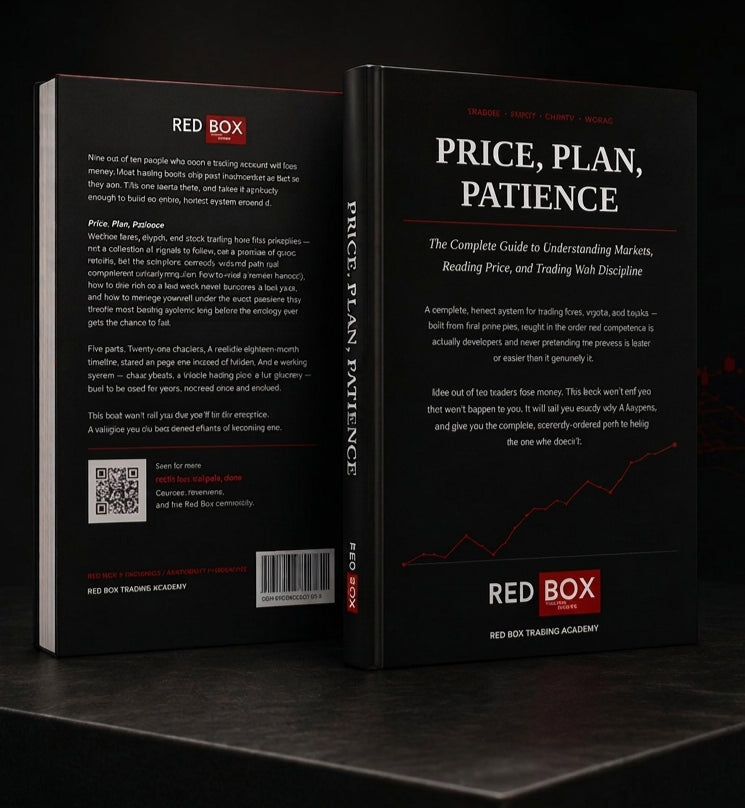
Trading • Forex • Crypto • Stocks
Get your Free Book
Price, Plan, Patience
The Complete Guide to Understanding Markets, Reading Price, and Trading With Discipline.
Sign up with your email and get the full book for FREE.
No spam. Unsubscribe anytime.
Ready to go beyond the free lessons?
The Academy turns this vocabulary into a structured, four-stage system, with a Discord community to match your progress.

Red Box Trading Academy invited you to join
Red Box Trading Academy